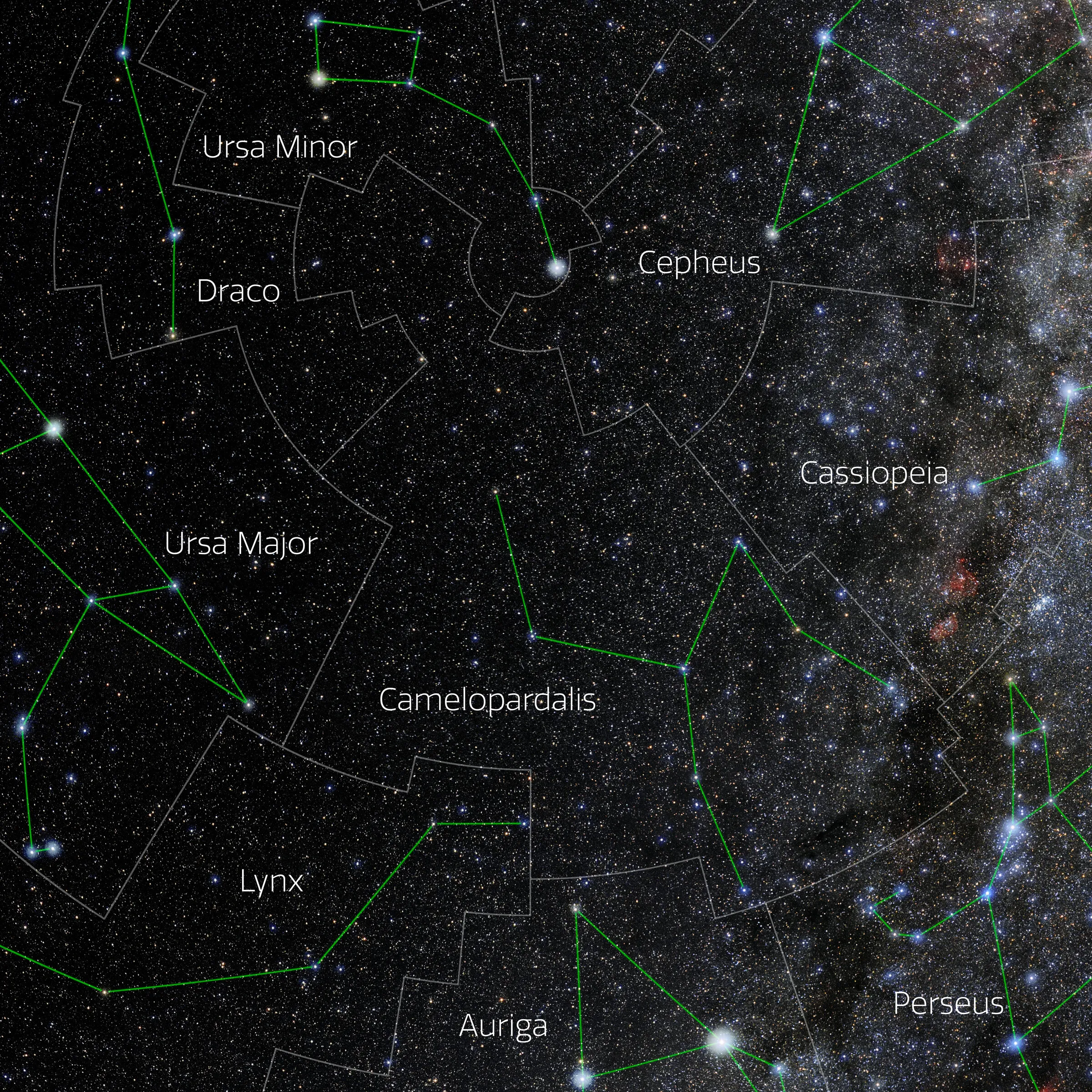
Camelopardalis
The giraffe. Genitive Camelopardalis, abbreviated Cam. Introduced by Plancius.
Area
756.86 sq°
18 of 88 by size
Brightest star
β Camelopardalis
magnitude 4.03
Best seen
December
on the meridian at midnight
Visible from
90°N to 37°S
some part above the horizon
Where it is
| Measure | Value |
|---|---|
| Centre | 5h 41m, +70.8° |
| Declination range | +52.7° to +86.1° |
| Naked-eye stars | 149 to magnitude 6.5, 0 to magnitude 3 |
| Borders | Auriga, Cassiopeia, Cepheus, Draco, Lynx, Perseus, Ursa Major, Ursa Minor |
Principal stars
Camelopardalis has no star brighter than magnitude 4, so its five brightest are listed instead.
| Star | Magnitude | HR |
|---|---|---|
| β Camelopardalis | 4.03 | 1603 |
| HR 1035 | 4.21 | 1035 |
| α Camelopardalis | 4.29 | 1542 |
| HR 1155 | 4.47 | 1155 |
| 7 Camelopardalis | 4.47 | 1568 |
Deep sky
No object in Camelopardalis carries a Messier number or a common name. It contains catalogued objects all the same, identified by number only.
My Sky
Rise, highest and set over your place, for any night: Camelopardalis
Further info
Sources
Principal stars: Bright Star Catalogue
Deep sky: NGC 2000.0
Area and borders: IAU constellation boundaries