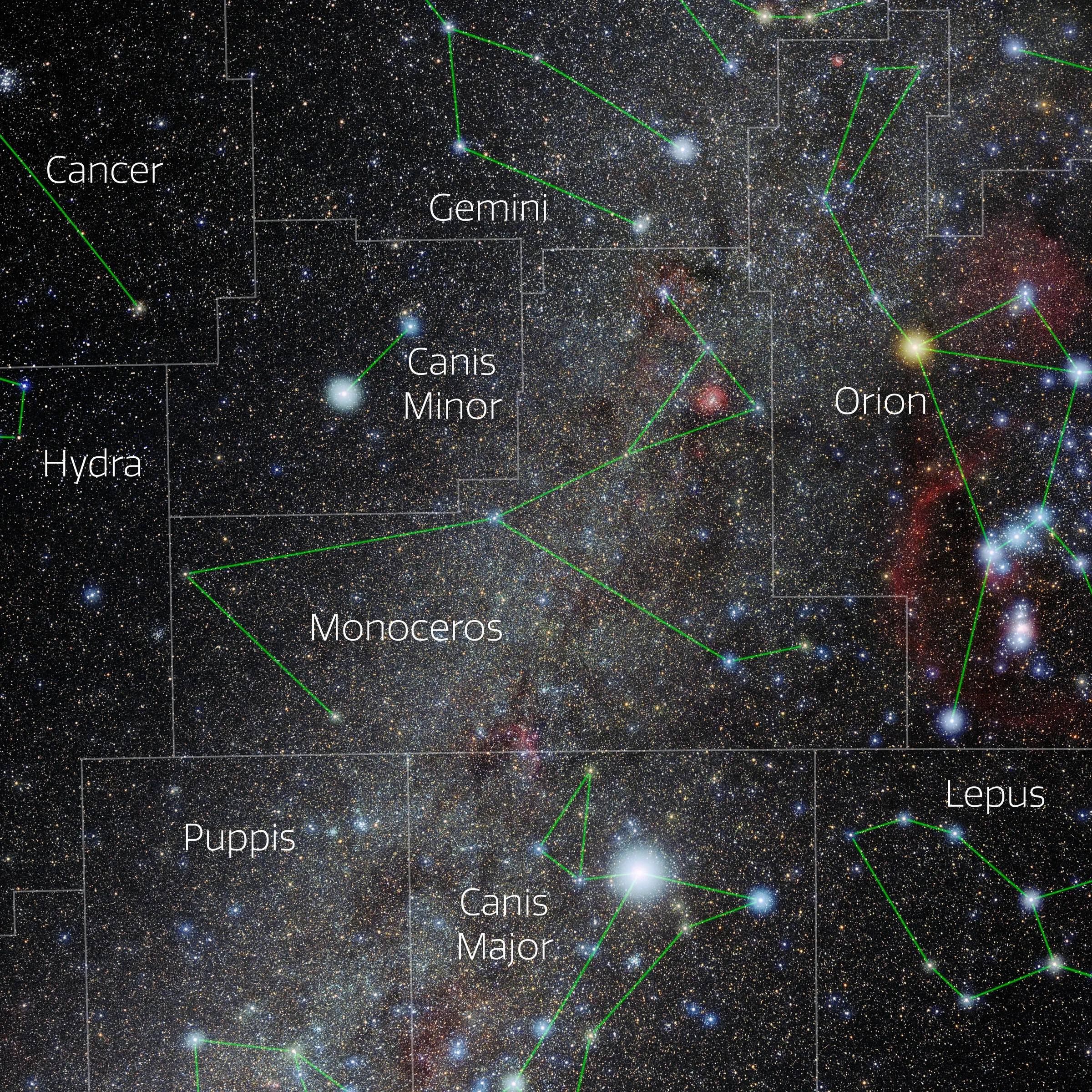
Monoceros
The unicorn. Genitive Monocerotis, abbreviated Mon. Introduced by Plancius.
Area
481.56 sq°
35 of 88 by size
Brightest star
α Monocerotis
magnitude 3.93
Best seen
January
on the meridian at midnight
Visible from
Everywhere on Earth
some part above the horizon
Where it is
| Measure | Value |
|---|---|
| Centre | 7h 01m, −2.7° |
| Declination range | −11.3° to +11.9° |
| Naked-eye stars | 135 to magnitude 6.5, 0 to magnitude 3 |
| Borders | Canis Major, Canis Minor, Gemini, Hydra, Lepus, Orion, Puppis |
Principal stars
Every star to magnitude 4, brightest first.
| Star | Magnitude | HR |
|---|---|---|
| α Monocerotis | 3.93 | 2970 |
| γ Monocerotis | 3.98 | 2227 |
Deep sky
Objects with a Messier number or a name people use.
| Object | Catalogue | Type | Magnitude | Size |
|---|---|---|---|---|
| M50 | NGC 2323 | Open cluster | 5.9 | 16.0 |
| Christmas Tree cluster | NGC 2264 | — | 3.9 | 60.0 |
| Rosette nebula | NGC 2237 | Nebula | — | — |
| Rosette nebula | NGC 2238 | — | — | — |
| Rosette nebula | NGC 2239 | Open cluster | — | 16.0 |
| Rosette nebula | NGC 2246 | Nebula | — | — |
| Hubble's variable neb | NGC 2261 | Nebula | — | 2.0 |
- Magnitude: — where NGC 2000 gives none.
- Size: the largest dimension, in arcminutes.
My Sky
Rise, highest and set over your place, for any night: Monoceros
Further info
Sources
Principal stars: Bright Star Catalogue
Deep sky: NGC 2000.0
Area and borders: IAU constellation boundaries